Marathon Time Limits: Distinguish Watch Time, Net Time and Course Closure
A personal watch, an official result and an operational cutoff may use different reference points. Read the race’s timing and support rules before assuming one number describes all three.
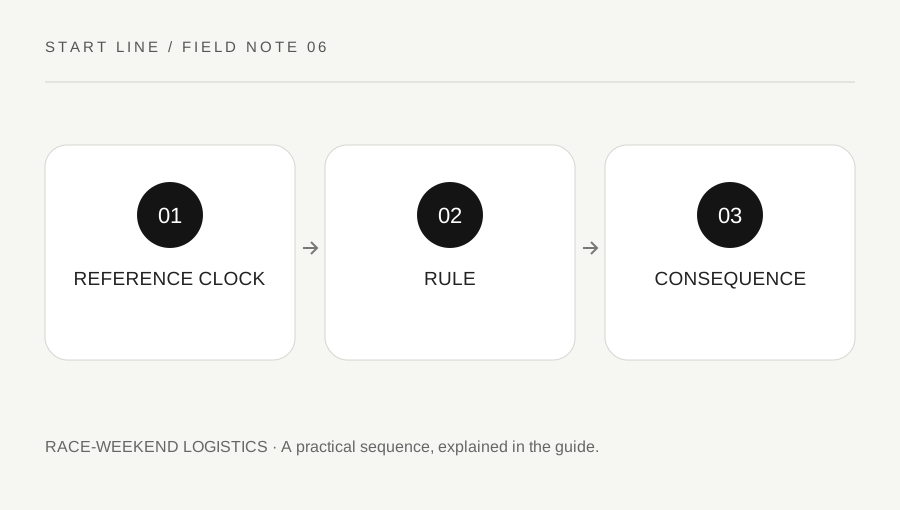
Original explanatory diagram. Examples illustrate a method or decision; they are not claims of personal testing.
Name each timing measure
Gun time starts from the relevant official start signal, while net time measures the interval between a participant crossing the start and finish timing points under the event's system. A personal watch may differ because of button timing, pauses, GPS distance or settings.
Read the event's rules for which measure applies to results, awards, qualification and operational limits. Chicago's official rules distinguish timing procedures and explain consequences outside its time limit. That does not establish an identical rule at every marathon or for every category.
Avoid treating a watch display as permission to remain on a closed course. The organizer's operational clock and checkpoint process may be defined differently. Record the exact reference point stated in the official policy rather than using the word time without a label.
Read the cutoff as a complete rule
Find whether the limit applies at the finish, intermediate checkpoints, a moving closure or another defined boundary. Check what happens when it is missed: support changes, removal from the course, transport or result status may be described. Do not assume a single finish limit answers every checkpoint question.
Some races publish a pace or a time measured from a particular wave. Read the edition and category carefully. A limit quoted in a forum may omit its starting reference or belong to a previous route.
For a hypothetical example, an event could define six hours from a participant's crossing, or six hours from a stated final-wave start. Those are different rules. The example is not a claim about a specific race; it shows why the reference clock must be known before planning around the number.
Keep planning arithmetic separate from health decisions
You can use official distances and times to understand the logistics of checkpoints, but arithmetic does not assess whether continuing is medically appropriate. If you feel unwell or receive an instruction from event medical staff, seek help and follow qualified guidance rather than chasing a calculated remaining pace.
Do not interpret a small buffer as a guarantee. Crowds, stops, conditions and course operations can change the real situation. A planned average is an assumption, while the official instruction on course applies to what is happening now.
If the rule is unclear before the race, ask the organizer a specific question: which start reference, which checkpoint and which consequence. This is more useful than asking whether the event is friendly to a certain pace without identifying the rule you need to understand.
Review results through the official process
After the race, use the official result source and correction procedure if a timing issue appears. Keep the bib and relevant evidence private when contacting support. Do not modify a timing device or assume an app estimate is the final published result.
For a worked review, a runner's watch shows one duration while the official net result differs slightly. They first check pause settings and the event's timing definition, then use the official query route if the discrepancy needs review. A small mismatch does not automatically prove a race error.
Finish with a table containing measure, reference point and purpose. This keeps watch feedback, official results and course operations understandable without forcing them into one number. The useful outcome is knowing which rule governs each decision and where to ask for clarification, not a promise that a personal clock can override event support limits.
A practical checklist
Choices are saved in this browser. Reset them here or clear this site’s browser storage.
Questions that come up
Does my watch prove I am inside every course limit?
No. Official limits can use different reference points or checkpoints. Read the specific event rule.
Are net time and gun time identical?
Not necessarily. They use different start references and can differ when a participant crosses after the signal.
Can a pace calculation decide whether I should continue when unwell?
No. Seek appropriate medical help and follow qualified event staff. Timing arithmetic is not a health assessment.
References & scope
Background references checked on 18 October 2026. Worked examples and diagrams are original teaching material.